

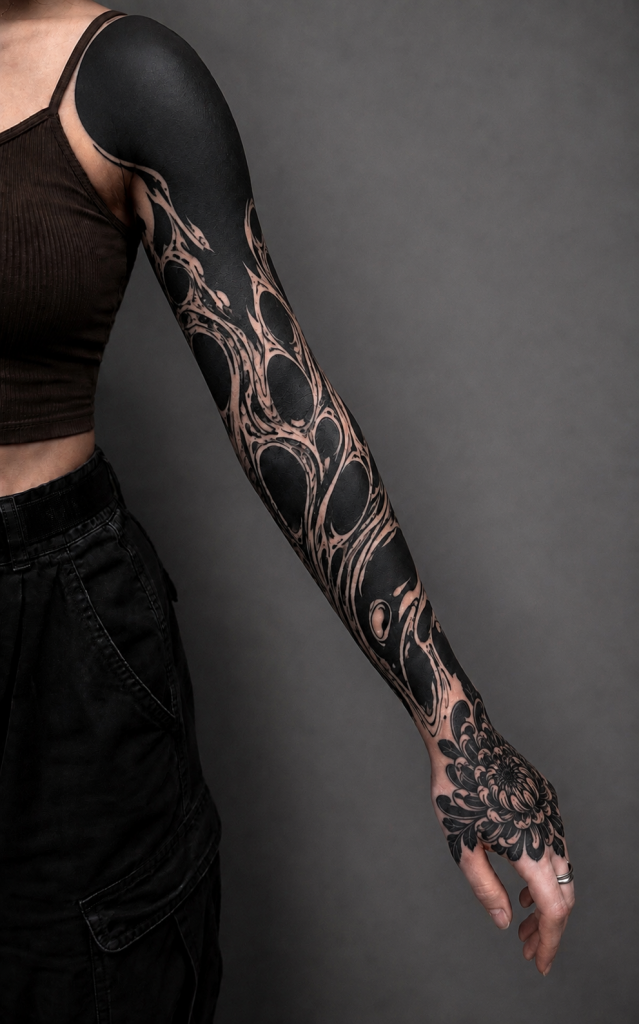
Blackout and blackwork tattoo styles have evolved from a niche trend into one of the most powerful expressions of contemporary body art. Characterized by deep pigment saturation across large areas of the body, these styles stand out for their striking aesthetic, unrivaled cover-up capabilities, and advanced techniques like white-on-black layering.
This technical guide breaks down the origins of blackout, how it differs from traditional blackwork, high-flow anatomical placement like the arm and forearm, and healing protocols to ensure smooth, pitch-black blocks of color without fading.
What Is a Blackout Tattoo and How Does It Differ from Blackwork?
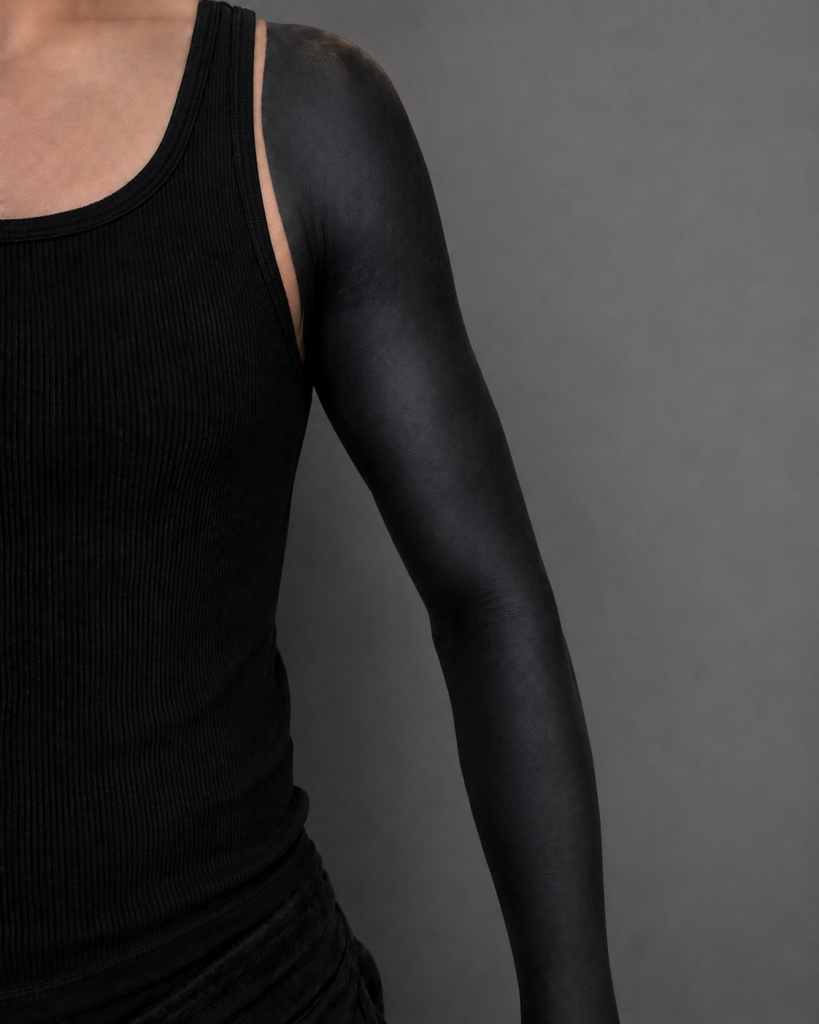
A blackout tattoo involves saturating continuous sections of skin with solid, opaque black ink. The goal is to build rich, uniform blocks of color that work directly with your body’s natural lines. While rooted in Polynesian tribal tattooing, today it offers the cleanest, most definitive solution for erasing old tattoos without undergoing laser removal.
Blackwork, on the other hand, is a broader umbrella term for any design executed exclusively in black ink. This includes geometric patterns, dotwork, woodcut/engraving styles, and heavy linework—leaving open skin to create contrast.
Key Distinction: Every blackout is an extreme form of blackwork, but not all blackwork is a blackout.
Tatuaje Blackout con Blanco: La Técnica "White on Blackout"
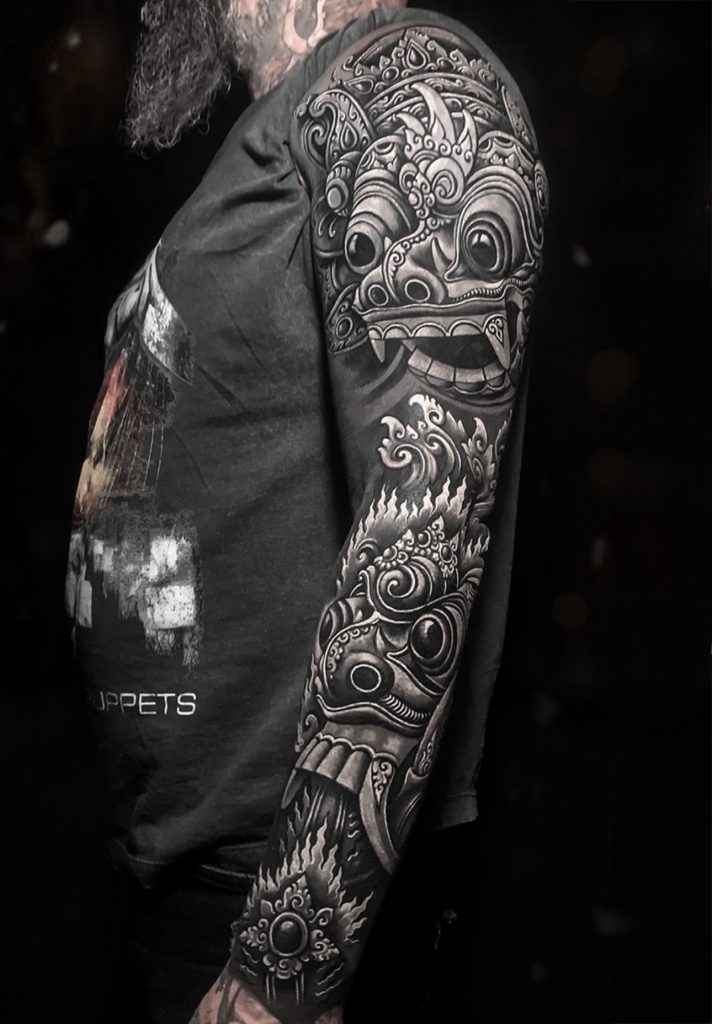
White on blackout is one of the biggest technical breakthroughs in modern tattooing. It involves packing high-density white pigment directly over skin that has already been tattooed solid black and fully healed.
Layered Execution Process
- Base Black Saturation: The initial blackout is performed and left to heal completely for a minimum of 8 weeks. The dermis must fully regenerate before taking a new layer of pigment..
- White Ink Packing: Using specific needle configurations (Magnum or Round Shader), white pigment is packed over the dark background.
- Visual Result: Geometric designs, crisp lines, or patterns that create a raised visual effect and striking negative contrast.
Technical Note: Because the underlying black pigment and top melanin layer absorb light, achieving a bright, pure white on black usually requires 2 to 3 touch-up sessions.
Most Requested Areas: Arm and Forearm Blackout Tattoos
The natural flow of the upper limbs makes the arm and forearm the most popular canvases for blackout compositions.
Arm Blackout Tattoos
An arm blackout spans from the shoulder to the wrist as a full sleeve. It allows for clean geometric cut-offs at the biceps or seamless transitions into blackwork pieces across the chest, back, or neck.
Forearm Blackout Tattoos
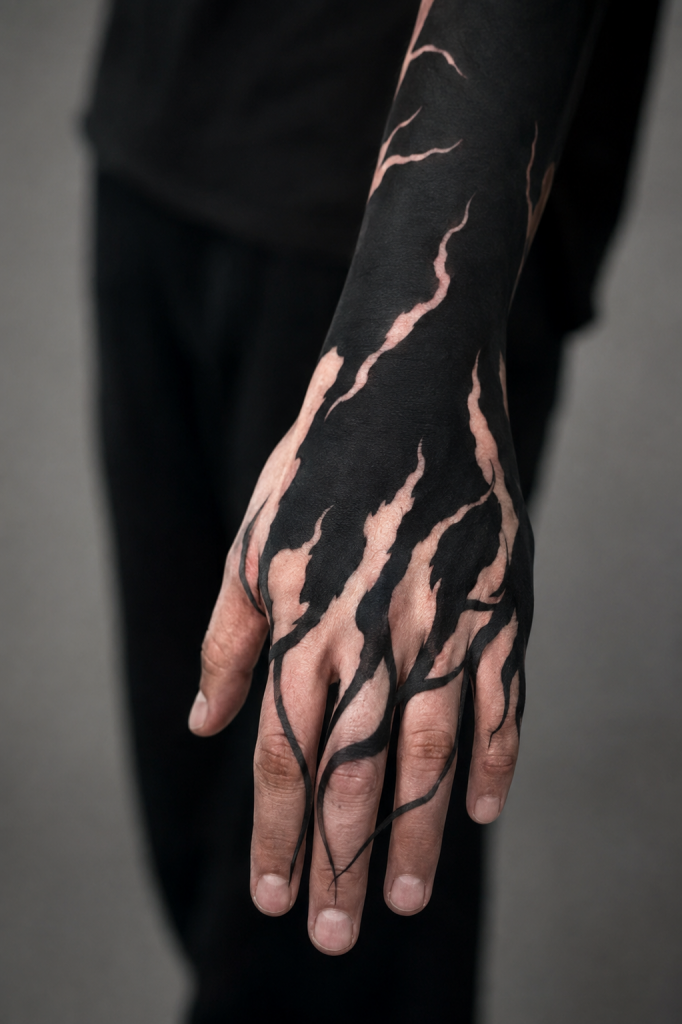
Forearm blackouts are ideal for anyone wanting a defined block or a wide armband. It is the go-to spot for covering up names, symbols, or older pieces, transforming unwanted designs into a bold, clean statement.
Technical Comparison: Blackout vs. Traditional Blackwork
- Technical Criterion: Ink Saturation
- Blackout Tattoo: 100% Solid (No bare skin remaining)
- Blackwork Tattoo: Variable (Combines lines, shading, dotwork, and bare skin)
- Technical Criterion: Pain Level (Scale 1 to 5)
- Blackout Tattoo: 4 / 5 (High, due to repeated passes required to pack ink)
- Blackwork Tattoo: 3 / 5 (Moderate)
- Technical Criterion: Cover-Up Effectiveness
- Blackout Tattoo: Maximum (Completely hides any previous artwork or lettering)
- Blackwork Tattoo: Medium (Requires integrating the old design into the new linework)
- Technical Criterion: Healing Time per Layer
- Blackout Tattoo: 3 to 4 weeks
- Blackwork Tattoo: 2 to 3 weeks
Critical Aftercare to Prevent Patchiness in Blackout Tattoos
A blackout tattoo requires a strict healing protocol to prevent faded patches or uneven ink density:
- Wet Healing: Use second-skin healing bandages (polyurethane films like Dermalize or Saniderm) during the first 48 to 72 hours to trap natural fluids and speed up epidermal recovery.
- Thin Layer of Moisture: After removing the film, apply a thin layer of neutral healing cream. Avoid over-applying so you don’t clog your pores.
- SPF 50+ Sun Protection: UV radiation is the main factor in fading black pigment. Once healed, daily sunscreen application is mandatory to keep the color deep and rich.
Frequently Asked Questions
Are blackout tattoos more painful than traditional ones?
Yes. The pain level is higher due to the saturation process. Working over the same area repeatedly with larger needle groups to pack solid black sensitizes the skin far more than fine-line work.
Can I get a blackout tattoo if I have a darker skin tone?
Absolutely. Tattoo ink sits in the dermal layer, making blackout highly effective across all skin tones. However, for white-on-black techniques, lighter skin tones will yield a higher visual contrast right away.
How many sessions does it take to cover an old tattoo with blackout?
It typically takes 1 to 2 sessions to set a solid black base (depending on how dark the old tattoo is) and 1 touch-up session after 8 weeks of healing if you plan to add white ink details on top.
Get Your Blackout or Blackwork Tattoo at Volt Gallery Tattoo
Executing a blackout tattoo isn’t just about packing black ink—it takes precise machine control to prevent over-traumatizing the skin and avoid hypertrophic scarring or keloids.
At Volt Gallery Tattoo, we specialize in solid saturation, geometric blackwork, and white-on-black techniques. We work with high-torque machines, large-gauge Magnum needles, and premium, high-density vegan black inks.
Whether you live in Tenerife or Salou (Tarragona)—or are traveling through the area—and want to transform an old piece or start a fresh arm or forearm blackout, our team will custom-design a piece tailored to your anatomy.
Ready to plan your project? Book your appointment or request a consultation at Volt Gallery Tattoo at our South Tenerife or Salou studios.